Best Low MOQ Clothing Manufacturers for Startups and Growing Apparel Brands
Choosing the right low-MOQ partner is one of the biggest hurdles for an emerging clothing brand. The best low-MOQ clothing manufacturer depends on whether you need zero-MOQ testing, small-batch domestic production, marketplace sourcing, or a scalable factory that can start around 50 to 150 pieces and grow as you do.
In the apparel industry, there is no single "best" low MOQ factory that works for everyone. If you want zero inventory risk for graphic tees, Print-on-Demand (POD) is the ideal choice. If you are developing a luxury designer capsule, a local Los Angeles small-batch studio might be the perfect fit. But if you are a startup or a growing fast-fashion brand that needs to test trial orders—and then scale into repeatable bulk production without constantly switching suppliers—you need an overseas factory with a clear path from test runs to large-scale output.
At Mostnica Garment, a Guangzhou-based OEM/ODM manufacturer of everyday apparel, we frequently receive inquiries from brands testing the waters. We are a strong choice for buyers needing affordable fast-fashion women's apparel, dresses, T-shirts, hoodies, and children's clothing, especially when they want a production partner for trial orders that can scale to 3,000+ pieces later. However, low MOQ should be judged by style, color, fabric, and customization depth—not just a single number on a website.
This guide provides a transparent shortlist and criteria for evaluating low MOQ clothing manufacturers, helping you match your current production stage to the right type of supplier.
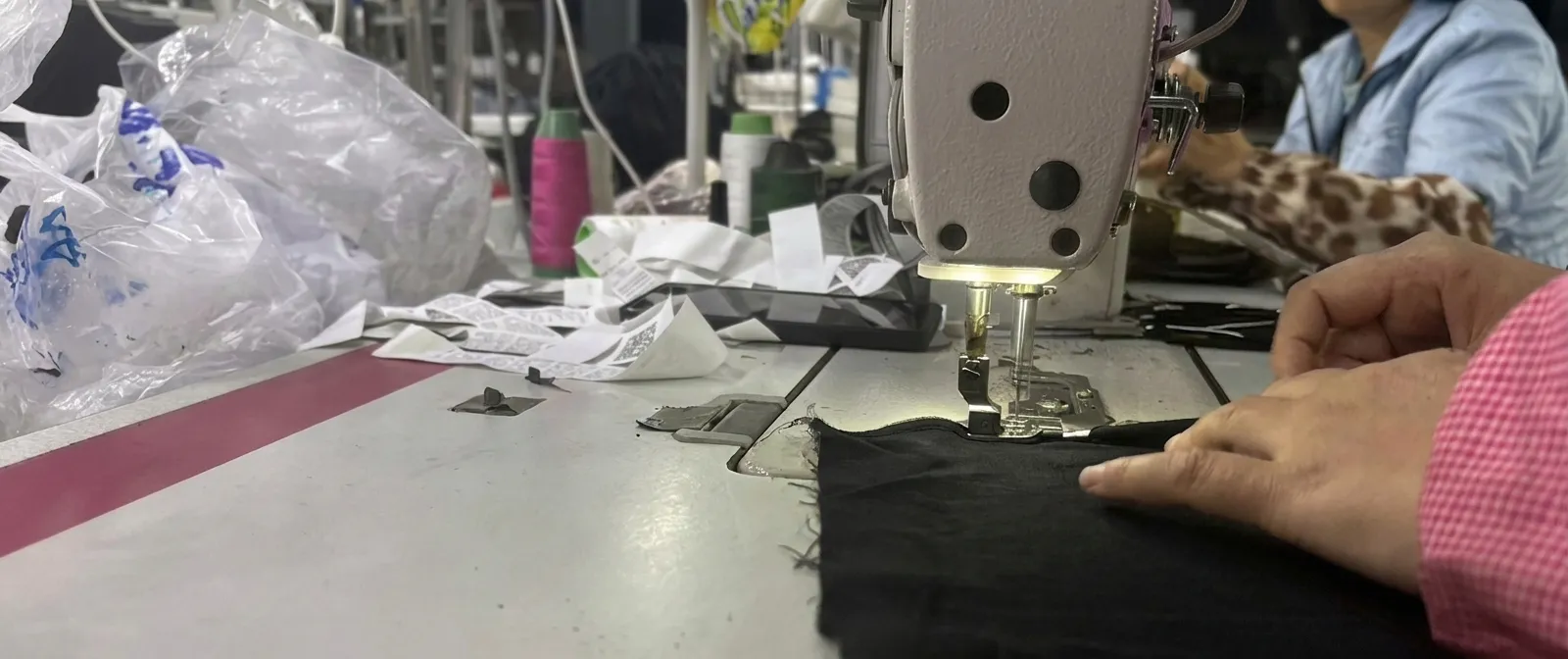
Guangzhou clothing factory production area handling both low-MOQ trial orders and scalable bulk production.
What Counts as Low MOQ in Clothing Manufacturing?
MOQ stands for Minimum Order Quantity—the smallest number of units a factory is willing to produce in a single order. In the apparel industry, this is not an arbitrary rule designed to punish small brands. It is a mathematical necessity based on the minimum amounts of fabric a mill will sell, the time it takes to dye materials, the cost to set up cutting machines, and the labor required to switch sewing lines.
When searching for "low MOQ," it is critical to understand the common buyer-facing ranges in the market today:
Order Model
Typical MOQ Range
Best For
Main Tradeoff
Print-on-Demand (POD) & Blanks
0 - 1 piece
Merchandise testing, influencer drops, graphic tees with zero inventory risk.
No original pattern making; lower margins; limited fabric options; not true cut-and-sew.
Very Small Batch Studios (Domestic)
10 - 50 pieces per style
High-end designer capsules, high-touch local development, luxury sampling.
Very high unit costs; limited capacity for large-scale retail replenishment.
Requires higher upfront capital; less flexibility for completely untested designs.
High-Capacity Factories
2,500+ units per SKU
Large retailers, wholesale distribution, established global brands.
Highest inventory risk; longest lead times; inflexible if a style does not sell well.
Important Nuance: An advertised MOQ of "100 pieces per style" rarely means you can order 100 completely different items. It usually means 100 pieces of a specific style, often divided into just one or two colors, across a standard size run (e.g., S-M-L-XL). The exact MOQ will always depend on the complexity of the fabric, print setups, embroidery, and whether the materials must be custom-milled or can be sourced from stock markets in locations like Guangzhou.
Quick Comparison Table: Shortlisted Manufacturers
The following is a curated shortlist representing different types of low-MOQ manufacturing options, from full-service OEM factories and localized networks to global marketplace solutions.
Supplier / Type
Best For
Advertised MOQ (Typical)
Customization Depth
Scale-up Potential
Main Tradeoff
Mostnica Garment
Affordable everyday apparel, women's fast fashion, scalable OEM/ODM
Lower margins, limited fabric control, not true OEM.
Criteria Used to Rank Low MOQ Manufacturers
To avoid the trap of simply sorting by the lowest number, successful apparel brands evaluate factories based on holistic production capabilities. A factory offering a 20-piece MOQ is useless if their samples are terrible, their quality control is non-existent, or they cannot handle a 1,000-piece reorder when your item goes viral.
MOQ Transparency: Does the factory clearly explain if the MOQ is per style, per color, per fabric, or per size mix? Are they transparent about the difference between blank customization and full cut-and-sew?
Product-Category Fit: A factory excellent at producing heavy canvas jackets might struggle with delicate chiffon dresses. Match the factory's core competency to your product.
Sampling and Revision Workflow: How long does it take to get a sample? Are they using available market fabrics to speed up the process, and what happens if a sample needs a revision?
Ability to Scale Up: Can the factory smoothly transition from a 100-piece test order into a 3,000-piece planned bulk production? A reliable scale path is critical.
QC System and AQL Clarity: Do they perform fabric inspections, in-line checks, and final Acceptable Quality Level (AQL) inspections before packing?
Communication and Tech Pack Review: Do they thoroughly review your Tech Pack before quoting, or do they blindly accept any design without checking technical feasibility?
Private Label Support: Can they manage your custom neck labels, care labels, hangtags, and branded packaging even at lower minimums?
Logistics and Incoterms: Are they clear on EXW vs. FOB terms? Can they cooperate with your nominated freight forwarder and provide accurate packing lists?
Best for: Buyers needing affordable everyday apparel, fast fashion women's wear, dresses, tops, pants, T-shirts, hoodies, and children's clothing with a clear trial-to-bulk scale path.
Why it fits the low-MOQ search: Mostnica actively supports trial orders—typically around 100 pieces per style/color for cut-and-sew projects depending on the material, and often as low as 50 pieces for light customization on blanks. With our base in Guangzhou, we provide incredibly fast 5-8 day sampling (when fabrics are available) and robust in-house design and ODM showroom support.
What to verify before ordering: Exact MOQ depends heavily on fabric availability, color dying requirements, trims, and workmanship complexity. Always submit a Tech Pack or reference sample to confirm your specific project's minimums.
Main limitation: We are not a one-piece Print-on-Demand (POD) provider. While we offer trial orders, buyers should understand that lower quantities have higher unit costs, and the buyer should plan to manage destination logistics and import duties through a trusted freight forwarder.
2. Maker's Row Network / U.S. Domestic Factories
Best for: Brands prioritizing "Made in USA" labels, seeking domestic communication, fast local sampling, and smaller initial runs.
Why it fits the low-MOQ search: The platform connects you with local American suppliers, many of which specialize in small runs between 50 and 500 units to help startups test the market.
Main limitation: Domestic manufacturing inherently carries significantly higher unit costs compared to overseas production. It is generally better suited for premium, high-margin positioning rather than affordable, mass-market everyday apparel.
3. TEG (The Evans Group)
Best for: Designer capsule collections and luxury brands needing extremely small-batch production with high-touch, atelier-style development in Los Angeles.
Why it fits the low-MOQ search: TEG advertises small batches from 10 to 50 pieces per style, which is incredibly rare for true cut-and-sew.
Main limitation: This is a premium service. The cost of bespoke development and tiny production runs will be prohibitive for a standard contemporary or fast-fashion brand looking for affordable retail margins.
4. Nofal Apparel
Best for: Ultra-low MOQ custom streetwear and sportswear produced in Pakistan.
Why it fits the low-MOQ search: They advertise extremely low minimums, often starting at just 20 pieces per design.
What to verify before ordering: Buyers should carefully verify factory details, quality references, actual lead times, and shipping costs. Their core product focus is sportswear, streetwear, and leather, which differs from standard fast-fashion everyday apparel.
Main limitation: Product category is highly specialized; may not be suitable for general women's fashion, dresses, or casual woven tops.
5. Huilin Fashion
Best for: Buyers looking for a China-based factory offering a broad multi-category apparel range, including men's, women's, and kids' clothing.
Why it fits the low-MOQ search: They advertise low MOQs of around 50 pieces per design across a wide variety of categories like T-shirts, hoodies, jeans, and loungewear.
What to verify before ordering: Because they claim such a broad range of capabilities at very low minimums, buyers should conduct careful sampling to verify production quality across different garment types.
Main limitation: Extreme category breadth sometimes means a lack of deep specialization in one specific construction technique.
6. Gui Ping Clothing
Best for: Startups looking for Guangzhou-based private label and custom apparel with highly startup-focused messaging.
Why it fits the low-MOQ search: They advertise a clear 100 pieces per style/color minimum for private label orders.
What to verify before ordering: Their content often makes strong end-to-end and DDP claims. Buyers should treat these as marketing claims and verify exactly when and where the risk of loss transfers during shipping.
Main limitation: Aggressive end-to-end logistics claims may mask the true costs of importing; ensure the unit price breakdown is fully transparent.
7. Tuer Garment
Best for: Brands sourcing Guangzhou-made women's clothing with a private-label or startup positioning.
Why it fits the low-MOQ search: They advertise minimums around 150-200 pieces per color and style, using sample and production speed as a key selling point.
What to verify before ordering: Compare their specific women's apparel focus against your own category needs. Evaluate their scale path and QC detail to see if they match your long-term volume plans.
Main limitation: Their focus is somewhat narrower, heavily skewed toward specific women's apparel rather than a broader everyday fashion catalog.
8. Alibaba Marketplace Suppliers
Best for: Buyers who want to cast a wide net, gather dozens of quotes rapidly, and see many visible listings offering small quantity options.
Why it fits the low-MOQ search: Searching for "small quantity clothing" on Alibaba will yield thousands of listings aggressively advertising 50-piece minimums.
What to verify before ordering: You must personally vet the supplier's actual manufacturing capabilities versus a trading company front.
Main limitation: The vetting burden falls entirely on the buyer. Quality, factory type (trading company vs. real factory), compliance, communication, and production consistency vary massively. Buyers must rigorously check business licenses, demand samples, and arrange third-party inspections.
9. Printful and Print-on-Demand (POD) Platforms
Best for: Graphic designers, merch testing, and influencers who want absolutely zero inventory risk.
Why it fits the low-MOQ search: The MOQ is zero. You only pay when a customer buys a product.
What to verify before ordering: Check their blank catalog to ensure the base garments align with your brand's quality expectations.
Main limitation: It is not custom manufacturing. You are printing on pre-existing blank garments. You have limited control over the fabric quality, cannot alter the pattern or fit, and your profit margins will be significantly lower than traditional private label manufacturing.
Low MOQ by Buyer Stage
Your ideal supplier depends entirely on where you are in your brand's lifecycle:
Testing a graphic tee idea: If you just need to see if an audience likes a logo or graphic, POD or blank customization is the safest route. There is no need to engage a cut-and-sew factory yet.
Testing a real cut-and-sew style: If your value proposition is a unique fit, drape, or fabric (e.g., a custom maxi dress or tailored streetwear pant), you must use an OEM factory. Choose one that can sample effectively and produce 50 to 150 pieces per style.
Testing a private-label capsule: Choose a factory with strong label and packaging support. You need clear MOQs per style and color so your brand presentation looks professional even in small batches.
Scaling a proven SKU: Once a style validates, the "lowest MOQ" ceases to be the goal. You must prioritize factory capacity, QC standards, reorder consistency, fabric continuity, and reliable delivery windows.
Large buyer testing new season drops: Even major brands use low-MOQ pilot runs. A 100-piece trial order can validate a bold new colorway before committing to a 3,000+ piece planned production run.
Low MOQ by Product Type
Not all garments are created equal. The product category directly impacts how realistic a low MOQ is:
T-shirts, Hoodies, and Sweatshirts: These are easier to produce at lower minimums when utilizing standard fabrics (like standard cotton jersey or french terry) from open markets. Custom fabric knitting or custom dyeing will immediately raise the MOQ.
Dresses, Tops, Pants, and Women's Fashion: Fit, fabric drape, trims, and size grading are paramount here. Sampling is critical. A 100 pcs/style/color trial is highly practical to test the grading and market reception.
Children's Clothing: Sizing, safety requirements, and specialized trims need extra care. Low MOQ is possible, but buyers must be vigilant about compliance for their target markets.
Activewear and Streetwear: Material performance (stretch, moisture-wicking), complex print/embroidery setups, and shrinkage tolerances significantly affect MOQ. Factories need enough volume to justify setting up complex machines.
The Real Cost of Low MOQ
Low MOQ manufacturing reduces your inventory risk, but it comes with unavoidable tradeoffs that brands must calculate into their retail prices:
Higher Unit Price: Setup costs are divided by fewer garments. A dress that costs $12 at 1,000 units might cost $22 at 100 units.
Less Fabric and Color Leverage: You are usually restricted to "in-stock" market fabrics and available colors. Custom Pantone dyeing usually requires a fabric mill minimum of roughly 300 to 500 kilograms of fabric.
More Sampling Cost Per Unit: Pattern making and sample fees make up a much larger percentage of your total expenditure on a small run.
Fewer Economies of Scale: Cutting, sewing, and shipping are less efficient in small batches.
The Strongest Path: Use a low-MOQ order strictly for market validation. Once validated, negotiate better pricing by reordering winning styles in larger quantities using the approved, finalized production file.
Questions to Ask Before Choosing a Low MOQ Factory
Never sign an invoice based on an advertised MOQ without asking these clarifying questions:
Is the stated MOQ per style, per color, per fabric, per print, or per size mix?
Is this quote for blank customization (printing on existing stock) or original cut-and-sew manufacturing?
What is the timeline and fee for the pre-production sample?
Are you using in-stock market fabric, or does this MOQ require custom fabric sourcing?
What is the process if the first sample is rejected due to factory error?
Use a POD service instead. We focus on B2B apparel production.
Ultra-Luxury Couture Capsule
Poor Fit
N/A
Better suited for a local atelier or specialized small-batch studio.
Ideal Mostnica Projects: We partner best with buyers who have a clear product direction—whether that is a comprehensive Tech Pack or physical reference samples. We excel at everyday apparel, women's fast fashion, casualwear, and children's clothing. We are the ideal factory for a brand that needs a reliable trial order (around 100 pcs) but wants a production partner capable of scaling that same garment up to thousands of pieces utilizing Guangzhou's vast fabric resources and our strict factory QC.
Logistics Note: Mostnica primarily discusses production from FOB or EXW terms. While we gladly recommend trusted freight forwarders and cooperate seamlessly with export documentation, buyers should plan to use a freight forwarder they trust to manage international shipping, customs clearance, and destination-side risk.
MOQ is only one buying signal. If your main concern is how a limited run is developed, controlled, delivered, and repeated, use the separate comparison of small-batch clothing manufacturers.
Practical Decision Checklist
If you only need one sample for personal use: Do not use an overseas manufacturing factory. Hire a local tailor.
If you need 1 to 20 graphic items: Use Print-on-Demand (POD) or a local screen-print shop.
If you need 20 to 50 complex designer samples: Use a specialized small-batch studio (and prepare for high costs).
If you need 50 to 150 private-label or cut-and-sew pieces: Compare low-MOQ OEM factories like Mostnica Garment to validate your styles with acceptable retail margins.
If you need 500+ and expect repeat orders: Stop focusing on the lowest MOQ headline. Prioritize a factory's QC processes, capacity, reorder consistency, and communication.
If you need 3,000+ for a retail rollout: Run a trial order for validation first, approve the pre-production sample, and then schedule your planned bulk production windows.
If you are a startup or growing brand ready to build a real manufacturing path that doesn't stop at low MOQ, the next step is preparation. Get your Tech Packs ready, define your target fabrics, and understand your numbers.
Ready to Test Your Styles?
Share your Tech Pack, reference samples, or design ideas with Mostnica. We can discuss realistic MOQs, sampling timelines, and the path to scaling your brand's production.